
Remember what it used to feel like to walk into a classroom?
Teacher writing on the board. The scratch of chalk against the board as the teacher filled it, line after line. Rows of desks facing the front. Students quietly copying; not even a mouse dared to make any sound. Teachers took over discussions. Student learning often meant listening, memorizing, and getting the right answer.
For many of us, remembering and looking back at our school life meant this was what learning looked like.
Now walk into a Keys classroom.
A teacher stands and converses beside a student. Anchor charts, students’ idea maps, and classroom jobs take up most of the board space. Students talking, collaborating, debating, taking each other’s perspectives. Students confidently brainstorming with the whole class about something they just learned and discovered. On another day, students might be researching, creating, experimenting, or revising thoughts and ideas that did not quite work the first time.
This is what school life looks like at Keys: active, collaborative, anchored in inquiry and connected to the world around us.
Learning Begins with Curiosity
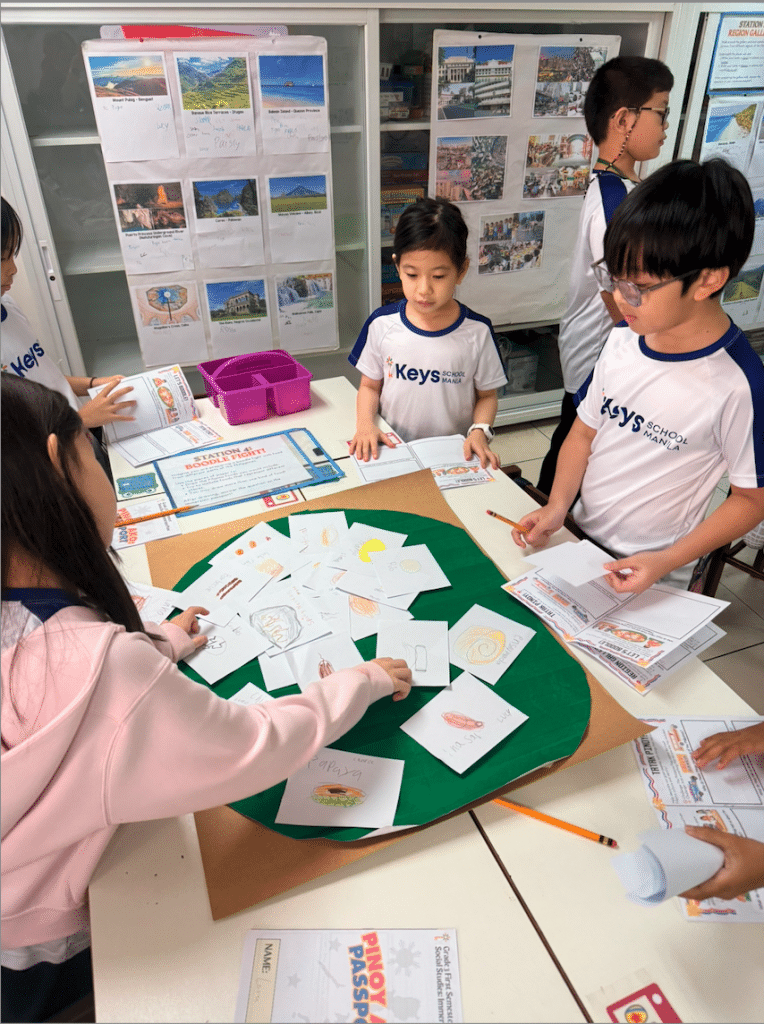
Step into a Grade 3 Keys classroom and witness how students learn more about their identity as Filipinos in Social Studies. The subject aims to help students appreciate our country’s people, community, culture, and traditions. Rather than simply memorizing information about different regions, students are encouraged to wonder and ask questions: “Why is NCR an important region?” “How does where we live influence the way we live?”
In a Keys classroom, the teacher facilitates learning by providing resources and creating experiences that allow students to find answers and make meaning of their inquiries. This may look like students looking at maps, collaborative tasks, mini debates, looking at real-life problems, and connecting what they discover to their own experiences and learning.
Keys emphasizes student agency, giving students meaningful opportunities to make choices, express their ideas, take ownership of their learning, and contribute to decisions that shape their learning experiences.
Here, the goal is not simply to know about the Philippines or memorize facts about it, but to become curious about their identity and culture as Filipinos.
Becoming Active and Informed Citizens
In a Grade 6 classroom, students are ready to tackle more complex ideas about government, citizenship, democracy, and society. Most of the time, a lesson starts with a question about the world around them. This may look like students examining a real-world situation, identifying an issue, discussing different points of view, and considering what responsible action could look like. Teachers support these conversations by challenging students to go beyond their initial ideas and thinking with questions like, “What makes you say that? What evidence supports your idea? Is there another perspective we should consider?”

In this way, students learn that having a stand is only the beginning. They also need to listen, question, support their ideas, and remain open to changing their thinking when they encounter new information.
As active and informed citizens, students are equipped to make thoughtful decisions and create positive change in their communities.
Across grade levels, learning at Keys is not measured only by how much information students can remember. We look at what students are curious about, and how we can find opportunities to answer their questions. Can they ask meaningful questions? Can they make connections? Can they explain their thinking? Can they work with others? Can they apply what they have learned to something unfamiliar? Can they create something that demonstrates genuine understanding?
At Keys, learning is intentionally designed to give students opportunities to practice 21st-century skills while providing the guidance, feedback, and support they need along the way.
Most of the time, the most important moment in a lesson is not when a student arrives at the correct answer. It is the entire process of finding answers to their wonderings. It is the moment they stop and say, “Wait—I think I see it differently now.”
That is learning in action, and that is what we hope to see every day in our classrooms at Keys.
More Stories
October 9, 2026
Growing with Purpose: Mid-Year Goal Setting and Feedback
September 2, 2025
Back to School, to Values: Living the Keys Student Profile
September 2, 2025
Faculty Feature: Preparing for the 2025-26 Academic Year